French Flow logo
A1 Lesson 1

FLOW LAB 6 – Eat Out Successfully

Learn how to greet someone, ask how they are, and say goodbye politely in French.

What you will learn

After this lesson, you will be able to:

  • greet someone politely or informally;
  • ask how someone is and answer naturally;
  • end a short conversation politely.
Log in to see the lesson

Total duration: ~30 min

FLOW LAB 6 – Eat Out Successfully

Focus Video

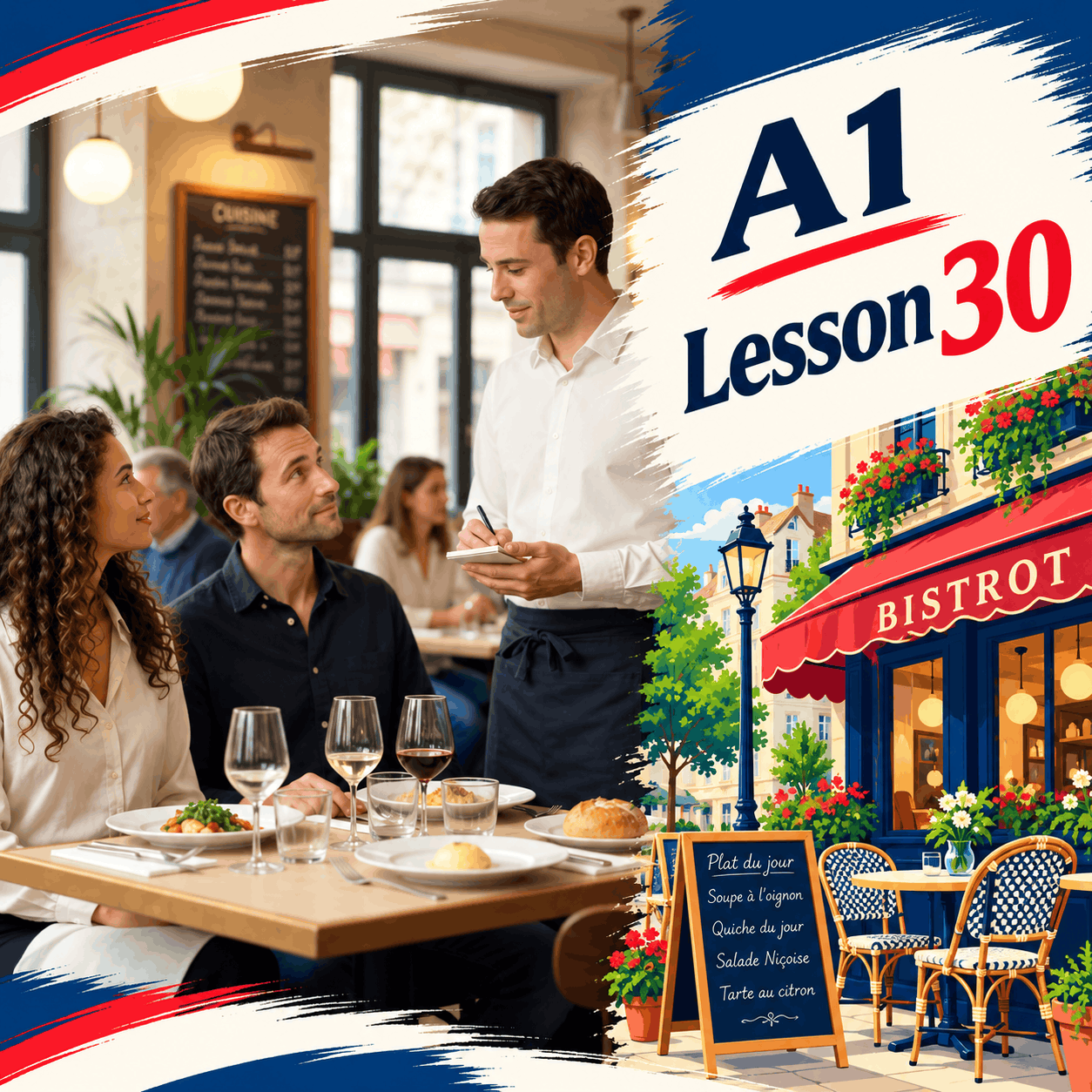
Emma and Victor are having lunch at a restaurant in Lyon. Emma wants to order a dish but needs to check one ingredient before deciding.

Full Transcript

Waiter: Vous avez choisi ?

Emma: Oui. Je vais prendre le poulet.

Victor: Pour moi, le poisson.

Waiter: Et comme boisson ?

Emma: De l’eau, s’il vous plaît.

Emma: Est-ce qu’il y a des champignons dans la sauce ?

Waiter: Oui.

Emma: Alors sans champignons, s’il vous plaît.

Waiter: Bien sûr.

English Translation

Waiter: Have you chosen?

Emma: Yes. I’ll have the chicken.

Victor: For me, the fish.

Waiter: And to drink?

Emma: Water, please.

Emma: Are there mushrooms in the sauce?

Waiter: Yes.

Emma: Then without mushrooms, please.

Waiter: Of course.

Check the Video

Question 1

What does Victor order?

  1. chicken

  2. fish

  3. salad

Answer: b

Question 2

What does Emma want removed?

  1. cheese

  2. onions

  3. mushrooms

Answer: c

Micro-task

The waiter asks:

Et comme boisson ?

You want water.

What do you say?

  1. De l’eau, s’il vous plaît.

  2. Un kilo d’eau.

  3. C’est direct.

Answer: a

Essential Phrases

This Flow Lab recycles the most useful language from Lessons 26–29.

Core 5

Vous avez une table pour deux ?

Pronunciation: /vu za.ve yn tabl puʁ dø/
Meaning: Do you have a table for two?

Example:

Bonsoir, vous avez une table pour deux ?

Je vais prendre…

Pronunciation: /ʒə vɛ pʁɑ̃dʁ/
Meaning: I’ll have…

Example:

Je vais prendre le poulet.

Est-ce qu’il y a… ?

Pronunciation: /ɛs kil ja/
Meaning: Is there / Are there…?

Example:

Est-ce qu’il y a du fromage ?

Sans…, s’il vous plaît.

Pronunciation: /sɑ̃ … sil vu plɛ/
Meaning: Without…, please.

Example:

Sans champignons, s’il vous plaît.

L’addition, s’il vous plaît.

Pronunciation: /la.di.sjɔ̃ sil vu plɛ/
Meaning: The bill, please.

Example:

Excusez-moi, l’addition, s’il vous plaît.

Plus

Qu’est-ce que vous conseillez ?

Pronunciation: /kɛs kə vu kɔ̃.sɛ.je/
Meaning: What do you recommend?

Example:

Je ne sais pas quoi choisir. Qu’est-ce que vous conseillez ?

Pour moi…

Pronunciation: /puʁ mwa/
Meaning: For me…

Example:

Pour moi, la salade.

Je ne mange pas de…

Pronunciation: /ʒə nə mɑ̃ʒ pa də/
Meaning: I don’t eat…

Example:

Je ne mange pas de viande.

C’est très bon.

Pronunciation: /sɛ tʁɛ bɔ̃/
Meaning: It’s very good.

Example:

Le poisson ? C’est très bon !

Je peux payer par carte ?

Pronunciation: /ʒə pø pe.je paʁ kaʁt/
Meaning: Can I pay by card?

Example:

Je peux payer par carte ?

Main Dialogue

Audio

Sofia and Marc are having dinner at a restaurant.

Sofia: Bonsoir. Vous avez une table pour deux ?

Waiter: Oui, bien sûr. Par ici.

Marc: Merci. Qu’est-ce que vous conseillez ?

Waiter: Le poisson est très bon aujourd’hui.

Marc: Parfait. Je vais prendre le poisson.

Sofia: Et pour moi, la salade. Est-ce qu’il y a du fromage ?

Waiter: Oui, un peu.

Sofia: Je ne mange pas de fromage. Sans fromage, s’il vous plaît.

Waiter: Bien sûr.

A little later…

Marc: Le poisson, c’est très bon ! Excusez-moi, l’addition, s’il vous plaît.

Sofia: Et je peux payer par carte ?

Waiter: Oui, bien sûr.

Quick Check

  1. What does Sofia want removed from her salad?

  2. Which two phrases finish the restaurant interaction?

Answers:

  1. Cheese.

  2. L’addition, s’il vous plaît and Je peux payer par carte ?

How It Works

A successful restaurant interaction can be divided into five moves.

Enter

Vous avez une table pour deux ?

Order

Je vais prendre le poisson.

Pour moi, la salade.

Clarify

Ask about an ingredient:

Est-ce qu’il y a du fromage ?

Explain a restriction:

Je ne mange pas de fromage.

Request a change:

Sans fromage, s’il vous plaît.

Respond

When everything is fine:

Merci.

Parfait.

C’est très bon.

Pay

L’addition, s’il vous plaît.

Je peux payer par carte ?

The whole interaction is:

enter → order → clarify → respond → pay

Micro Grammar

Pattern 1 — Est-ce que + sentence

You have already used:

Est-ce qu’il y a… ?

Now notice the wider pattern:

Est-ce que + statement

turns a simple statement into a question.

Statement

Il y a du fromage.

Question

Est-ce qu’il y a du fromage ?

Another useful restaurant example:

Vous avez un dessert sans lait.

↓

Est-ce que vous avez un dessert sans lait ?

Examples

Est-ce qu’il y a des noix ?

Est-ce qu’il y a du fromage ?

Est-ce que vous avez une table pour deux ?

At A1, you do not need to change the word order.

Just add:

Est-ce que… ?

Pattern 2 — Je peux + infinitive

Use:

Je peux + verb ?

to ask whether something is possible.

You already know:

Je peux payer par carte ?

Now extend the pattern:

Je peux avoir la salade sans fromage ?

Je peux prendre le dessert ?

Je peux payer ici ?

Mini Cheat Sheet

Je peux + payer… ?

Je peux + avoir… ?

Je peux + prendre… ?

Pronunciation Focus

In natural speech:

Est-ce qu’il y a…

sounds like one compact group:

/ɛs kil ja/

And:

Je peux avoir…

flows together:

/ʒə pø a.vwaʁ/

Practise the whole chunks, not individual words.

Phrase Builder

One compact restaurant problem-solving pattern

ASK → CLARIFY → REQUEST

Est-ce qu’il y a + ingredient ?

↓

Je ne mange pas de + ingredient.

↓

Je peux avoir + dish + sans + ingredient ?

Guided Examples

Est-ce qu’il y a du fromage ?

Je peux avoir la salade sans fromage ?

Semi-Guided

Est-ce qu’il y a ____________________ ?

Je peux avoir ____________________ sans ____________________ ?

Independent Production

Create one request:

______________________________________________ ?

Practice

Exercise 1 — Choose the Best Response

— Vous avez choisi ?

You want chicken.

  1. Je vais prendre le poulet.

  2. Je suis le poulet.

You need to check for nuts.

  1. Est-ce qu’il y a des noix ?

  2. Où est l’arrêt ?

You are ready to leave.

  1. L’addition, s’il vous plaît.

  2. Un kilo, s’il vous plaît.

Answers: 1a, 2a, 3a

Exercise 2 — Put the Meal in Order

  1. Je peux payer par carte ?

  2. Vous avez une table pour deux ?

  3. Je vais prendre le poisson.

  4. Est-ce qu’il y a du fromage ?

  5. L’addition, s’il vous plaît.

Correct order:

b → c → d → e → a

Exercise 3 — Solve the Restaurant Situation

You want:

  • a table for two;

  • chicken;

  • water;

  • no mushrooms;

  • to pay by card.

Create the complete interaction.

Include:

Vous avez une table pour deux ?

Je vais prendre…

Est-ce qu’il y a… ?

Sans…, s’il vous plaît.

L’addition, s’il vous plaît.

Je peux payer par carte ?

Now perform it aloud without reading.

Survival Kit

Vous avez une table pour deux ?

Do you have a table for two?

Je vais prendre…

I’ll have…

Est-ce qu’il y a… ?

Is there / Are there…?

Sans…, s’il vous plaît.

Without…, please.

L’addition, s’il vous plaît.

The bill, please.

Download the lesson files

Save these resources to keep practicing offline.

Download the lesson files

Save these resources to keep practicing offline.

Découvrir la France

“Bon appétit !”

What do French speakers often say just before someone starts eating?

A very common expression is:

Bon appétit !

It is a simple way to wish someone an enjoyable meal.

You may hear it from:

  • friends;

  • colleagues;

  • family;

  • sometimes restaurant staff.

Simple French

— Voilà votre plat.

— Merci !

— Bon appétit !

— Merci !

Remember

Bon appétit ! is one of the easiest and most useful cultural phrases to recognise around a meal in France.

Final Challenge

FLOW LAB 6 — Eat Out Successfully

You enter a French restaurant with another person.

Your mission is to manage the whole meal.

Stage 1 — Enter

Ask for a table:

Vous avez une table pour deux ?

Stage 2 — Order

Ask for a recommendation:

Qu’est-ce que vous conseillez ?

Then order:

Je vais prendre…

or:

Pour moi…

Stage 3 — Clarify

You need to check one ingredient.

Ask:

Est-ce qu’il y a… ?

If necessary:

Je ne mange pas de…

or:

Je suis allergique à…

Then request:

Sans…, s’il vous plaît.

Stage 4 — Respond

During the meal, say:

C’est très bon.

or:

Merci, c’est parfait.

Stage 5 — Pay

Finish with:

L’addition, s’il vous plaît.

Then:

Je peux payer par carte ?

Full Mission Example

— Bonsoir. Vous avez une table pour deux ?

— Oui, par ici.

— Merci. Qu’est-ce que vous conseillez ?

— Le poisson est très bon.

— D’accord, je vais prendre le poisson.

— Et comme boisson ?

— De l’eau, s’il vous plaît.

— Très bien.

— Est-ce qu’il y a du fromage dans le plat ?

— Oui.

— Je ne mange pas de fromage. Sans fromage, c’est possible ?

— Oui, bien sûr.

A little later…

— C’est très bon, merci.

— Merci !

— L’addition, s’il vous plaît.

— Bien sûr.

— Je peux payer par carte ?

— Oui.

Communication Win

Do not memorise the script.

Your mission is to manage:

enter → order → clarify → respond → pay

If you can complete those five moves, you can handle a simple meal in French.

Self-Check

I can ask for a table.

Yes, on my own.
Yes, with a little help.
Not yet.

I can order food and a drink.

Yes, on my own.
Yes, with a little help.
Not yet.

I can ask about an ingredient.

Yes, on my own.
Yes, with a little help.
Not yet.

I can explain a simple food preference or restriction.

Yes, on my own.
Yes, with a little help.
Not yet.

I can respond naturally during the meal.

Yes, on my own.
Yes, with a little help.
Not yet.

I can ask for the bill and pay.

Yes, on my own.
Yes, with a little help.
Not yet.

UNIT 6 CHECKPOINT

I can handle a simple meal in French.

Yes — I’m ready for Unit 7.
Almost — I need a little more practice.
Not yet — I will review Unit 6 first.

Log in

or continue with

Don't have an account? Sign up